Showing posts with label women traveling Nepal. Show all posts

Friday, December 5, 2008

Reflections of Nepal

"In the last camp near the summit I had a very strange vision of all the human parts that I am made of. It is very difficult to keep the vision but I know that I could see a round picture with many pictures inside -- not only of my body but of my whole being. There was a lot of what my life has been, what I did these last years like seeing my life and my body and my soul and my feelings inside a mandala. I was not even sure if it was only mine or generally human, yours or anybody's, just a human being's. It was very, very strange." Reinhold Messner

Though these are not my words, when I read them I felt like YES! That is how it felt reaching the summit of Thorung La at 18,000 feet. It brought so many pictures of my life to my mind. Every person I've known and loved, every place I've been, every place I've yet to go, every word - spoken and unspoken, every dream, every feeling... they were all displayed before me like a like a poem of just images. Simultaneously tears and giggles came forward. My emotions were all celebrating the life moment that would surely be with me for the rest of time. Nepal has been like that for me. I am so carefree and happy, but daily I see images that remind me of how lucky I am to have the opportunity to be traveling, to be here in Nepal. There has not been a day when this thought doesn't cross my mind.

It's been nearly 80 days since I've arrived, though it feels like I've always been here somehow. Each day has been filled with memorable moments - some mundane, some adventurous, some hilarious, some a bit nerve-wracking, and all of them there to teach me something. I have so many photos, thoughts and reflections that it is hard to summarize, categorize and keep it interesting. For this last Nepal post, I want to share some photos that I feel really capture the essence of Nepal.
One of thousands upon thousands of temples in Kathmandu. This one devoted to Kali.

A child I met while trekking, saying "Namaste!" and undoubtedly asking for a sweet or a rupee.


One of a thousand photos I have of the beautiful Himalayas. Every moment of the day, the scenes change and each time I was completely in awe. I never, ever got tired of seeing the mountain vistas.


The daily migration of sheep both to and from their mountain feeding areas.


A public bath at Bhaktapur, one of the historic villages in Kathmandu. Most people in Nepal use public baths (though most are not as beautiful as this one) for all bathing and cleaning duties.

The lush, lush green of a rice paddy right before harvest. So much of the Annapurna region is covered with fields that families tend to religiously. During the Sanctuary trek, the fields looked like this, and during the Circuit trek, they had just been harvested and looked very different.

A typical shop selling socks, hats and other knit items.


One of the hundreds of times that Nepali students clamoured to be in front of my camera, and then to look at their photo with me. Invariably, this involved laughter and smiles.


A scene from Pashupatinath, one of my favorite temples in Kathmandu. These people are headed to the cremation of one of their family members. Notice their beautiful clothing...


Women returning from a long walk to the hills to gather food for their animals. Mind you, women do at least 80% of the heavy lifting in this country for reasons that I don't quite understand.


A few other random photos and observations...
People squatting to just rest or have a conversation, umbrellas in the sunshine, cows in the streets, terrible roads, landslides, insane traffic, the beautiful masala of Hinduism and Buddhism combined and the seamless way they are integrated into everyday life (like protecting cars), online chatting with a Buddhist lama, absolutely worthless police officers that seem to travel in groups of 20 and not do anything, public bathing rituals, affection between men and affection between women - but not affection between men and women, spontaneous celebrations including public dancing and singing, women at work, the hazards of just walking down the street (potholes, gutters that are two feet deep, random sharp objects, power lines that cross sidewalks), being offered tea in nearly every shop or office, , wandering sadhus (holy men) who will give you a tika for a few rupees, children in their school uniforms, girls with braids, signs that would never make it in the US, the enormous popularity of Brittany Spears and Avril Lavigne (that is the best America can offer?), the bright, vibrant colors of life, sheep and goats and buffalo, the enormous loads of porters in the mountains, the delicious taste of Pringles after a long day trekking, public transportation and fitting 28 people in a mini-van built for 12, shopkeepers who give you their cell phone numbers and invite you to their homes, Kathmandu's terrible air pollution, tuk-tuks and rickshaws, bridges that would never pass code in the US, sinks without pipes (so your toothpaste lands on your shoes), electrical wires that look like a birds nest that run the power system here, daily power outages ("load shedding") for 4-6 hours, "good price", the absolute natural beauty that is around every corner that you look, the obnoxious, ear-shattering horns in Kathmandu, getting out of the tourist areas toexperince life in the "real" towns, people sweeping their dirt floors, and so much more.


Of all the things that I am grateful for in Nepal, it is mostly the people that I have met (pictured here is Gerdien, Tine and Ellen) and traveled with. I am working to see every person as a teacher and every situation as a lesson...(thank you Liz Gilbert!). I have been enriched by my many experiences in this country and know that I will be back someday.

Next for me, South India on Sunday 12/7 through January if all goes as planned! (Yes, I promise to be safe.)

With love,
Pam


"The human soul does not want to sleep, desires to awaken and wants to win. When I become a traveler to the gold-shining peaks, I feel like I am going in search of heaven."
Mahakavi Laxmi Prasad Devkota

Tuesday, November 25, 2008

Giving thanks at 18,000 feet

Just before beginning my recent 18-day trek of the Annapurna Circuit, I sat in the lobby of a musty guest house in Besisahar in anxious anticipation of the election results. I'd urged my trekking companions to postpone our departure by one day under the auspices of allowing time for my toenail to heal (which it did), when in actuality what I really wanted was to know the results of the election before we departed! It was a really spectacular moment in my life, and one that I know I will never forget. Al Jazeera was the only news channel that I could see, and the reporters were obviously elated. The people in the lobby with me were from all around the world, and they were celebrating too. I cried as I listened to Obama's acceptance speech, and then told nearly everyone who would listen along the trail about our soon-to-be new president. I can tell you first hand that the world is really celebrating this victory as much as we are, and perhaps more. This vendor in a remote village of Nepal had a photo of Obama on his wares, and was ebullient when I told him I was from the USA.

The Annapurna Circuit trek was fantastic... we crossed Thorung La, the world's highest pass at 5,417 meters (nearly 18,000 feet)! This was a huge accomplishment for me personally on so many levels, but mostly the fact that I really didn't think that I could do this. Some of you may know I have asthma, and though it's relatively mild I've always somehow been convinced that it meant that I couldn't challenge my lungs in this way. Well I did, and they worked! ANYTHING is possible...

Though the pass was certainly a big part of the feeling of pride that I'm feeling now, trekking for 18 days for approximately 140 miles, gaining (and then descending) approximately 17,000 feet of elevation is a pretty darn big accomplishment too! The photo on the left is of Thorung Peak, which stands at just over 20,000 feet, and it's taken from the pass that I crossed. Doesn't it look small? The photo puts it into perspective for me!


There were so many beautiful points along the trek. We walked counterclockwise around the Annapurna range beginning in Bhulbhule, and ending in Nayapul. The towns and villages along the way exist year round for the most part, which makes it different from the Sanctuary trek. Most of the villages are hundreds or even thousands of years old. Braga, Upper Pisang and Kagbeni were a few of my favorite villages as they have retained the character of their age, and reflect the simple way of life for the residents.

From Kagbeni, you look north into the Kali Gandaki river valley, which is the direct route into the Mustang region (where I might have been if my permit had arrived...but life works out exactly as it is supposed to) and it is one of the most beautiful places I've ever seen. It is late in the day so my photos aren't great, but they show the daily afternoon migration of the sheep from the mountains back to their home in Kagbeni. There were probably 1,000 sheep, perhaps 4-5 large flocks, each with shepherds and dogs to keep them in check. One by one, they each crossed a narrow bridge across the river, until soon after they were running right by us. It was a seriously beautiful moment that I will never forget.

The majority of the people who live along this route live an agrarian lifestyle; the others run guest houses or other services for tourists. We saw people farming potatoes, corn, millet, rice, cabbage, cauliflower and sugar cane. Mostly, the women do the harvesting work. The men handle the animals and plows. In the higher elevations, there were yaks, sheep and goats everywhere. At one of our guest houses that sat at about 4,000 meters I even had a chance encounter with a yak in bathroom! Luckily, I wasn't in there when he was cleaning the floor with his tongue, but I did get to witness it.

On the west side of the pass the villages are along the historic trade route between Tibet and India, and so a very strong Tibetan influence is still felt today. We met several Tibetan refugees who are proud to tell you about their heritage, and sad when they think of the current status of their homeland. This one, Norju, is a 71-year-old who emigrated to Nepal in 1959 at the age of 23 -- the same year as the Dalai Lama. He now sells Tibetan handicrafts at a small stall along the route. I wear a bracelet that I bought from him to remind me of my experience and this place.

The group that I was with was a huge part of the fun of this trip, too. Considering that I only knew one of the other five people (three trekkers and two porters) before we all met at the trailhead, it could have been a disaster. Indeed, it worked out perfectly. It was Erik, a hydrologist from Minneapolis, Jaya an engineer from California, Gerdien my Dutch friend that I met in Kathmandu, and then Shova and Parvat our two porters. We all got along great and really had good energy. I'm sure we'll remain in touch for a long time to come. We shared many laughs, much sweat, a few tears, a lot of gas (!), and an unforgettable life experience. The gas I'm told is a natural function of our bodies when they get to high altitude. I'm sure the diet of constant carbohydrates (dal bhat, macaroni, porridge, and Pringles) didn't help either. Trekking is a good way to get to know someone really well!

A memorable moment occurred on the second day of the trek. Ellen, a German gal that I had met in Pokhara and been traveling at the same pace with (she saw me cry during Obama's acceptance speech!), had a terrible accident. She fell through a window at a lodge where she was having lunch. Our group arrived about 20 minutes behind her and her partner Tine, and got to witness the chaos and a lot of blood. Her major bleeding had been stopped, but she had at least a dozen other lacerations that needed cleaning and glass removed. I immediately got into nurse mode, broke out my first aid kit and began to clean up her wounds. Thankfully, there was a doctor only one village away (almost two hours) so we stayed until he came and stitched her up in four places. Amazingly, Ellen and Tine continued their trek, and finished on the same day we did!


The flora and fauna are stunning...everywhere you look. I thought my plant-loving friends would appreciate seeing that poinsettias do actually grow in the wild! And, they grow to be 20-30 feet tall when given the chance!! And, did you know that there is such a thing as a rhododendron FOREST? They grow in the wild, and can reach 40-50 feet tall with trunks as much as 3 feet across. Certainly this is a reason to come back to Nepal in the springtime to get to witness it all in bloom.

Happy Thanksgiving to you all, and know that I give thanks to each of you for your support, friendship and love.


Friday, October 31, 2008

The Divinity of a Common Life

My hotel room in Pokhara looks right into the backyard of a typical Nepali family. Every morning, by 6:30, the strong smell of wood smoke fills my room through my open window. Shortly after, the sounds of happy children playing and giggling dance through my still sleepy ears. I open my eyes and peek through the window to see a grandmother sitting rocking a child in a small chair, while mama is busy preparing breakfast. Three children, probably all under 7 years old, are playing a game of tag in the backyard courtyard.

Their roof is made of corrugated tin, and it's held to the home by a collection of large rocks. The home is simple, one or two rooms and the toilet is in a small closet in the backyard, and is a squat toilet that doesn't flush. (You use water from a bucket to do that). If the inside of their home is like others that I've seen, there is a couple of platforms that multitask both as couch and probably bed, too. Theirs is a very typical home.

Saturday is the one day of the week that the children don't have school. Yet they still rise early to settle into the rhythm of a busy life. It is very common to see very young children helping their mothers with the laundry, housework, gardening, watching over their younger siblings, or even sometimes working at the family business for most of the day. When not working, kids play in small groups, often with simple things like an old Coca-Cola crate, or a rock. There is a game that both adults and kids play and it always attracts a big group. I've never been able to see inside the huddles that form but this game can captivate audiences for hours at a time. All they have here to play with is their imaginations, and I've never seen happier, less fussy, more content people (both adults and kids) in all my life.

From my observations and also by what I hear, Nepali women work far harder than Nepali men. For the women, it is far more than just preparing the meals. It is harvesting the rice, drying it, hauling vegetables often from afar on their backs, tending to the garden, raising the animals, leading them to pasture to eat, milking them. When they are not preparing for a meal (always Dal Bhat), they are doing other household chores. At least 80% of Nepali families do not use or have a washing machine. Instead, they gather at the river's edge, in large or small groups, to do the washing and to take baths. This photo was taken in Pokhara at the Phewa River, about a one minute walk from where tourists pay $150 for a paragliding or rafting adventure. There are people doing laundry, doing dishes, bathing and getting water. The rivers are also often used as toilets...think about that.

The average Nepali family makes less than $500 per year - just over $1 per day. Life is very simple here. They do not ever complain about eating the same meal twice a day, every day (if they are lucky, sometimes it's only one meal per day). When I was helping the students write letters to their American sponsors, many of them said their favorite food was rice. I also thought their drawings that they would create for their sponsors were also very telling. One of the most striking to me was of a forest that was all stumps, and a mom at home crying. The title was "No firewood for cooking." These are the kinds of things that kids worry about.This image is of a woman who is using the sun's heat to dry her recently harvested rice. She was doing this for at least 12 hours without a break as far as I could tell. Her children were playing in the rice, and helping her sort the grains for sticks and rocks.

I had mentioned in a previous post that probably only 5% of Nepali people have cars. This means that people walk everywhere, all the time. There is never a time when the streets are not busy. There's an energy that just radiates from the earth. Another popular way for families to get around is by motorcycle. Unfortunately, this is the best photo that I've got (and it's certainly not the most remarkable) but if you look closely you'll see four people - two adults and two kids on this one. I have seen as many as five people riding one. Probably the most interesting (alarming?) scene on a motorcycle was a woman who was breast-feeding her baby while sitting sideways on the back. There was another child sitting in front on the gas tank. Today I saw a 5 year old sitting on the rear bike rack of his dads bicycle while holding his infant brother. His dad was peddling very fast and nearly ran me over! None of them had helmets on.

In my past posts from Nepal, I have been talking more about my experiences, and less about Nepali life. I hope this helps you appreciate the many blessings that you have in your rich and abundant life! I will begin trekking the Annapurna Circuit beginning on Thursday, and will return to blog life when I return sometime around November 25.

With love,
Pam


Wednesday, October 22, 2008

Two Glorious Cups of Tea

I think today was perhaps the second best day of my entire trip to Nepal so far. I know, it begs the question... what was the BEST day in Nepal? I still have to go with the Annapurna Base Camp day, but today was a close second.

After a hair-raising day yesterday (which ended with a ride in the tourist police car BACK to the restaurant in question, with the lights flashing, in a Kathmandu traffic jam - a 30 minute, very slow, very embarrassing ride), Gerdien stays at my hotel with me and we decide to get out into nature today to unplug from the previous day's chaos.

We head to a national park that is just at the outskirts of the Kathmandu Valley called Shivapuri. We are really looking forward to some much needed peace and quiet, and about 10 minutes into our hike we run into the largest all girl's school in Kathmandu, who's brought their entire student body to the park. Oh well, so much for peace and quiet. We walk as fast as we can (though Gerdien is in her skirt and Birkenstocks) to get past all the giggling girls. I must add that I am still feeling fit from my trek, and keep up with my tall Dutch friend just fine...

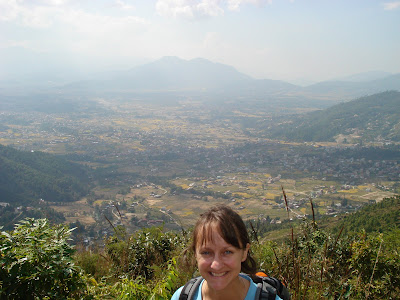
We arrive at Nagigumba, a small Buddhist monastery in the middle of the forest which is just beautiful. It's on a hill (in Seattle, we would call it a mountain as it's at about 5,000 ft.) overlooking all of the Kathmandu Valley as you can see in the photo above. We beat the kids to the top, and spend a few minutes getting hugged by the monks and taking photos. Then the girls, and two carloads of tourists from Hong Kong arrive at once. We have to leave too quickly to really enjoy this place.

I read in our tour book that there is an "alternative" route to get down that you "follow the ridgeline about three hours south to Kopan". Sounds delightful, and off the beaten path which is exactly what we are looking for. We walk for about a mile before we stop at a gate wondering where it goes. Thankfully, a local walked by and I asked and pointed, "Kopan?" He pointed just to the side of the gate where there was a very small path. OK, we're off. The trail is really steep, and there really isn't a defined path at all. Not too mention Gerdien is in her Birkenstocks, which makes it extra tricky.

We walk for about an hour in really strange territory, definitely what you would call OFF the beaten path. We're not sure we're going where we are supposed to be going (or, you could say we were EXACTLY where we were supposed to be) but we keep walking though the path has split about 20 times. We see two local village women carrying heavy loads and heading down the mountain. I do my best Nepali, and point down the mountain, "Kopan?" They agree that they are heading in the same direction (though the communication style was HILARIOUS as she kept pointing backwards, and indicating some path we were supposed to be on behind us, but then scolded us when we turned around.) We continue to follow them down. They are both wearing thin rubber flip flops, which inspires Gerdien to forget about her footwear situation!

They sit down at one point, and then we sit. I offer them water (which Hindu's usually decline because they don't like to share germs for some reason I don't quite get) and they both gratefully accept. Gerdien has an apple that we offer to them, and they ask if we can share it (in sign language, of course). I break out the Swiss Army Knife - definitely a good reason to carry one - and we all share a wonderful moment. We determine that Mama is 66 years old, and Didi (term of respect for an older sister) is 50-something.
After our break, we get up and continue walking. Again, Mama points backwards and kind of yells something, but when we turn around she shakes her head and indicates that we should continue walking with them. They sing and laugh all the way down the mountain, certainly amused by the unusual Westerners that they've stumbled upon and saved. Eventually, we arrive at a small town and the shop owner invites us in for tea. We sit, have no real conversation, but really share another wonderful moment in time. After the first glorious cup of tea, a young girl walks us to the trail where we are to head to Kopan, and we say goodbye to Mama and Didi.

About thirty minutes later, we arrive at what we think is Kopan (hint: there are about a million prayer flags) but there is no sign, and only a small path to where we believe it should be. We decide to take it, though the day is getting late and we only have about two hours of daylight left. The first building we come upon is definitely not the stupa, but the door is cracked and we hear some drumming and chanting coming from the building. Curious, we walk to the door and listen. A very young (8 years old?) Buddhist boy dressed in his dark red robes walks up the stairs, greets us, and invites us in.

Here's where the magic began, and unfortunately it just wasn't appropriate to break out my camera. Words will have to do...

As we enter, the music is getting louder and louder. We are led into a beautiful room downstairs that is filled with young Buddhist lamas. We kneel on the floor inside (after taking off our shoes, of course) and watch the ritual that I imagine has been going on for several hours at least, maybe all day. There are 20 boys in the room all sitting around the edges of the rectangular and beautifully, ornately painted room (think of a Buddhist Sistine Chapel, if you can), with tables in front of them. They sit in lotus position and they are all chanting from traditional texts. Each boy has a special instrument and they seem to be grouped by what instrument they are playing. Two boys get up and move, and they make room for Gerdien and I to sit at one of the tables. We gratefully oblige, though in all of the fuss they make for us, the chanting and music continue. It is almost like this is the most powerful dream I've ever had. Time stood still, and we just watched. Tears began to stream down my face and I just couldn't help it. This was a life moment that I would never forget, but yet I can hardly find the words to describe it.

The instruments included (in very un-technical terms) two 8' long trumpet-ish horns (that sounded a bit like a tuba with only one note), two other shorter one-note horns with something that resembled a clamshell on the end, two heavy pewter bells with beautiful sound, a pair of cymbals, a large hanging taiko drum, some Tibetan hanging cymbals, and a few other unidentified noise makers. The lama who seemed to be in charge was about 10 years old. The devotion and faith were absolutely stunning to watch. I made eye contact with a few of them, and they would smile and act a little shy, but never skip a beat in the ongoing chanting and ritual. After what seemed to be every page of the ancient texts that they were chanting from, a different boy would go to the front of the room before the alter of Buddha and perform a ritual that I couldn't quite see though I know it involved pouring water into a heavy pewter cup. The boy would then walk backwards through the room and as he did the other boys would cease playing their instruments and chanting, and they would all simultaneously through rice into the air, as if in celebration, and simultaneously shout in celebration.

Just as I was getting into the groove of recognizing what would be coming next, a young boy came before us and presented us with two cups of hot tea and a smile, as if to say, "You are welcome here." It was magic, as I had almost forgotten that I WAS really there since it was so mysteriously dream-like. It brought me back to life, and made me realize that this was all really happening.

We stayed in the magical room, both transfixed by the devotion and beauty of the ceremony, for about an hour. Realizing that daylight was running out, and that this ritual could go on for days, we showed our respect by offering them the most heartfelt "namaste" that I have motioned on this trip, bowed to the alter of Buddha, and quietly slipped out the door.

What a perfect, spontaneous, magical day! I'm looking forward to having a world of these kinds of moments during the next nine months away.

With love,
Pam

Tuesday, October 21, 2008

My encounter with the Kathmandu police

So, I am just hanging out in Kathmandu, awaiting a permit for my next trek. But as is the case in Nepal, you never really know what they mean when they say it. Perhaps I will get a permit. Perhaps I won't. I've been waiting for a week now so I'm starting to get impatient. Hopefully I will be able to post some news on my next adventure soon.

But for now, I have been kind of stalling in Kathmandu. Staying at the Pilgrim's Guest House in the Thamel district (the tourist neighborhood), they have welcomed me like family. They notice when I come and go and ask a lot of questions. Sometimes this is a good thing. Sometimes, it's not. That's another story.

But I digress... during my stalling in Kathmandu I have met a really wonderful Dutch woman named Gerdien (say "HAIR-deen" with a hard H like German). She's volunteering at the orphanage where I considered working, but have decided not to because the timing just doesn't work out. It's a blessing to meet her because she's easy going, funny, really friendly and adventurous. We've spent a few days hanging out in Kathmandu together, exploring neighborhoods and the sights. Last night, I met her at a restaurant near my guest house for a cheap, delicious dinner. We're dining with a guy from Australia that she's met. Everything is going along great, I'm getting travel tips from the Aussie and the lights go out. (This is a daily happening in Nepal, usually for about 3 hours at a time.) Nothing unusual. About two minutes pass and then the staff comes around and lights a candle at our table. About twenty minutes later, Gerdien goes to grab something out of her backpack, and it's gone.

Shit. We're freaked out. We're the only white people in the restaurant. The staff speaks a little English, but they don't seem very concerned about the missing bag. We call Som (I can not say enough nice things about my Nepali big brother) and he rushes to the rescue! Som calls Pilgrim's Guest House and they send two English speaking staff down to the restaurant to try to help us locate the missing bag, and to communicate the situation and what we have seen (which, unfortunately, is not much.) Her bag contained just about everything important (camera, credit card, bank card, sunglasses, money, address book, etc.) but fortunately, her passport is safe at home.

Som recommends that we NOT call the police as they are really good for nothing. But the staff from Pilgrim's says that it can't hurt, and we agree. Thirty minutes later (thank God no one is hurt) we are told that we need to walk to the Metro Police station about 10 minutes away to file our report. We arrive, and no one seems concerned. Our escort is asking questions, but they seem more concerned with who he is and why he is with two Western women. He's a member of the lower caste so they quiz him endlessly. It seems for at least the first five minutes there is no discussion of the missing bag.

A few minutes later we are just standing around. Just waiting. For what, we do not know. Then a truck arrives. It is a king cab truck with a canvas canopy over the back. We are told to get in the back of the truck. I'm not kidding, there were TEN police officers in the truck with us. And, thankfully, our escort from Pilgrims. We drive the long way through busy Thamel (as if to make a statement that the police really DO do something) and then arrive at the restaurant. Along the way, I decide that I have to break out my camera and take some photos. At first they are hesitant, and then they start posing for photos. Here's a few good ones...

The cops were hardly what you would call imposing or intimidating, as you can see. They all want to look at their image on my camera as soon as they are taken.

At McDonal's Fast Food Restaurant (really, this is what it's called), all ten police officers go inside and then emerge a few minutes later and say, "Well, your bag isn't inside." Of course it's not. Two hours have passed since the incident so it's not surprising that the bag has made a getaway. We're all certain that it was a staff person from the restaurant who took it. Total bummer. It's important to note that we are asked to come back the next day (today) to file our report. That's why we visited in the first place...

Today, we have spent the ENTIRE day dealing with the hassles of losing everything. Visiting the Dutch Embassy. Cancelling credit cards. Calling banks to get new cards issued. Calling her parents to wire the money. Getting the lock to her room at the orphanage opened (the key was in the bag.)

At the embassy, the officer there tells us to visit her friend who is a businessperson near the restaurant in question. He's buff, and well respected in the neighborhood. If he thinks they are bad and took the bag, maybe they will surrender the bag (minus the money, about $100 dollars which she's offered as a "reward"). We're going to try this Mob tactic a little later today.

A wasted day, but we both recognize that we are safe and healthy. Inconvenienced for certain, but glad to be together to walk through this stressful, crazy day. Thank heavens for friends in faraway places...